Opening Hours

 Book Online
 07 3003 0801
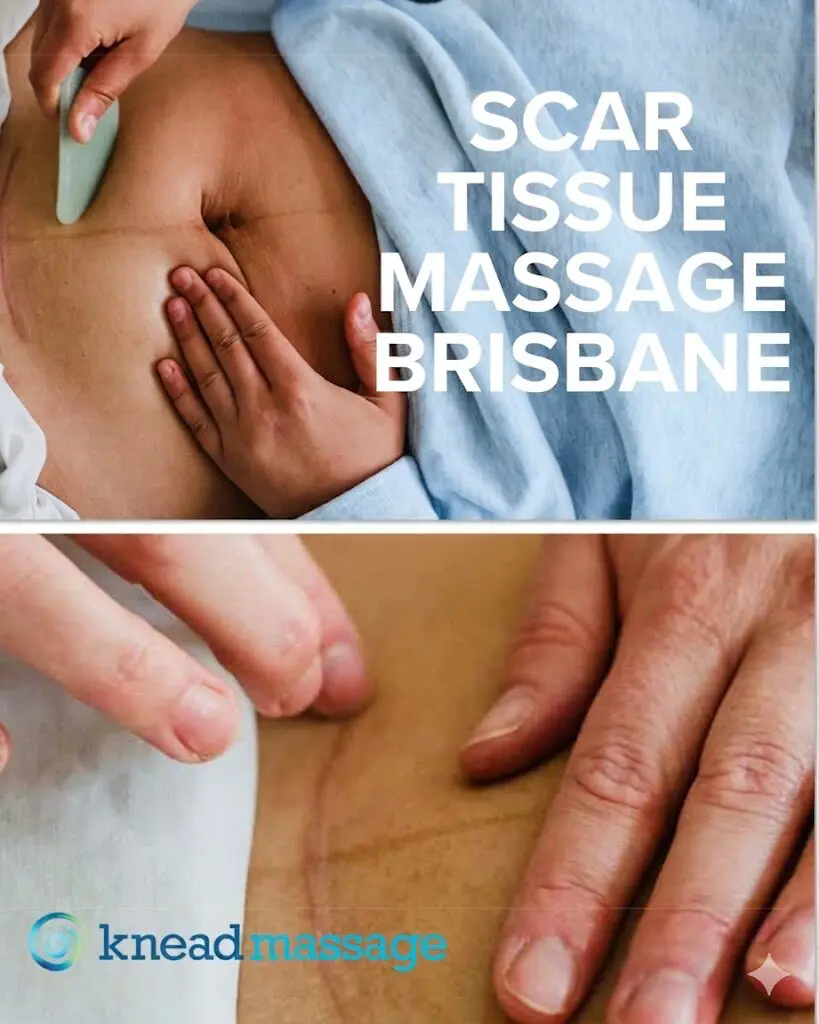
Scar Tissue Massage Brisbane CBD
Not every scar is problematic for health. However, scar tissue can be an underestimated source of pain and dysfunction through sensitized adhesion (reactive abnormal tissue), restricted movement, or reducing lymph and blood flow.
Most people don’t consider the scar itself as a driver of pain or loss of mobility.
Knead Massage provides a range of Scar tissue Massage techniques including:
- IASTM/GUA SHA
- Cupping
- Cross-friction
- Soft tissue massage
- Dry needling
- Lymphatic Drainage
These techniques assist the collagen of a scar to reorganize leading to:
- Reduced pain
- Less itching
- Improved pliability and range of motion
- Measurable changes in tissue thickness (improved appearance in more recent scars)
Why Do Scars Form?
When skin repairs itself after damage, it doesn’t rebuild perfectly. Scar tissue is structurally inferior to what it replaces — composed almost entirely of type I collagen the fibers are laid down in a disorganised, parallel pattern, rather than the woven, multi-directional mesh of healthy skin.
This results in less elasticity, reduced tensile strength, and impaired sensation.
How noticeable a scar becomes depends on wound depth, location, genetics, and after care.
Why does my old scar hurt?
Scars cause pain in several ways — often simultaneously.
Stuck layers. Tissue beneath a scar that should glide freely can become bound together. Movement becomes restricted, the body compensates, and pain shows up in places that seem unrelated to the scar.
Persistent tension. Specialised cells inside the scar stay activated long after the wound closes — continuously pulling at surrounding tissue, creating a low-level tension that never fully switches off.
Heightened sensitivity. Scars grow more pain-sensing nerve fibres than normal skin. The result: an area that overreacts to pressure, temperature, or even light touch.
What types of scars can be massaged?
- C-section scars
C scars can continue to cause tightness, pain, or restricted movement long after recovery. Treatment helps tissue remodel, restores mobility, and addresses deeper adhesions affecting posture, core function, and pelvic health. Many clients are ready at 8–12 weeks post-surgery. - Injury and accident scars
Tears, strains, and traumatic injuries often heal with disorganized scar tissue. Left untreated, this tissue tightens and restricts movement – leading to compensatory patterns throughout the body. - Burn scars
Often thick, tight, and inflexible (commonly hypertrophic). They restrict movement, pull on surrounding tissue, and can cause significant discomfort. - Surgical scars
The surgery may solve a problem, but the scar tightness increases with time and creates a source of, sensitivity, and restriction — typically from joint replacement to abdominal, cosmetic, or reconstructive surgery. - Lymph node removal scars
Disruption to the lymphatic pathway increases the risk of localised swelling, fibrosis, and restricted movement. Treatment combines scar mobilization with lymphatic drainage to address both restriction and fluid congestion - Burn scars
when healing has progressed past the painful stage - Acne scars
when healing has progressed past the painful stage - Scarring after tattoo removal
when healing has progressed past the painful stage
Abdominal Scar Release
Designed for people who have had a:
- Caesarean
- Hysterectomy
- Bowel resection
- Laparoscopic or oncological abdominal procedure
- Post liposuction
Each session assesses the scar and surrounding tissue. Using massage, cupping, and instrument assisted techniques, treatment releases tension through the:
- Abdominal wall
- Diaphragm
- Ribs
- Hip flexors
The low back and hips are also assessed (because they commonly contribute to scar discomfort even when the primary complaint feels “front-of-body”).
Abdominal scars can contribute to:
- Bladder and bowel dysfunction
- Chronic back pain
- Numbness or disconnection at the scar site
The Benefits of Treating Scars
- Enhanced function — Scars over joints or high-movement areas can limit mobility. When scar tissue attaches to bone, it creates a torsional stress on surrounding tissue — leading to pain, skin rupture, and in serious cases, ulceration.
- Better flexibility — Releasing deep scar tissue reduces tightness, restores movement, and relieves the pain that restricted layers create over time.
- Improved appearance — With treatment, scars can fade and integrate more naturally with the surrounding skin.
- Increased confidence — Feel comfortable in your skin again.
When should you massage scar tissue?
- Evidence informed best practice care is as soon as the wound is fully healed
- Often, that means starting around 8–12 weeks post-surgery
- Many scars are responsive to the described scar tissue massage techniques. When a scar is keloid and too adhered to the bone – it is likely that it requires plastic surgery.
Benefits of Scar Tissue Massage may include:
- Reduced pain
- Less tightness
- Increased blood flow
- Improved movement
When can scarring become a problem?
Commonly the deeper adhesions between muscle groups, around organs, and in deeper skin layers are where the worst limitations occur.
A 2003 study by Leidenius et al demonstrate that up to 86% of breast cancer survivors have a shoulder movement limitation following complete axillary dissection, and 45% experience limitation even after sentinel node biopsy.
Leidenius M, Leppänen E, Krogerus L, von Smitten K. Motion restriction and axillary web syndrome after sentinel node biopsy and axillary clearance in breast cancer. Am J Surg. 2003;185(2):127–130. [DOI: 10.1016/s0002-9610(02)01214-x
- Scar tissue can penetrate through connective tissue, muscle, and around organs (especially after surgery, serious injury, or burns)
- Fascia forms a continuous web from skin to bone, so restriction in one place can pull on tissue far from the original wound
- Post partum back pain is commonly attributed to ligament change and muscle atrophy, however there is evidence that adhesive scar tissue from C section scars can play a meaningful role. C-section scars have been shown to contribute to lower back pain, restrict hip movement and increase postural change.
Scar adhesion can lead to:
- stiffness
- Muscle weakness
- Movement problems
- pain on movement
- pain to touch
Tools such as IASTM or Gua Sha are well validated techniques for scar treatment.
When subcutaneous (below the skin) adhesions are properly addressed, the surface often becomes softer, flatter and more flexible.
What techniques do you use to remodel scar tissue?
Scar Tissue Release Therapy
Scar tissue massage works by helping realign disorganised collagen fibres after injury or surgery — reducing tightness, restoring movement, and improving appearance.
Treatment layers techniques for effect:
- IASTM, cupping and scar mobilisation
- Deep tissue work to target deeper fascial and muscle layers where adhesions cause the most restriction
- Lymphatic drainage (when needed) to reduce swelling and congestion
Result:
- Reduced fascial adhesions
- Better tissue mobility
- Softened discolouration
- A scar that moves with the body, not against it
IASTM has the strongest indirect evidence of any instrument-based technique for scar tissue disruption.
- Cheatham et al. (2016) reviewed seven RCTs and concluded there is meaningful evidence for scar tissue breakdown, fascia mobilisation, and improved collagen organisation
- Karmali et al. (2019) reached the same conclusion
- Proposed mechanism: controlled inflammation that drives fibroblast (cells that grow into repaired tissue) recruitment and tissue remodelling
- Large, direct human scar RCTs are still absent, but the biological rationale is compelling
IASTM uses cross-friction principles, delivered with instrumented precision. It likely shares — and amplifies — the same scar tissue effect. Gua Sha’s microcirculation evidence is robust for pain and fascia; direct scar application is an extrapolation from those mechanisms, but a logical one.
Cupping
Cupping works through suction, not compression.
- Lifts skin and subcutaneous tissue to create a decompressive force
- Increases local blood flow
- Decompresses fascial layers
- Promotes lymphatic drainage
- Helps release adhesions between superficial and deep scar layers that compression may not reach
Strong direct evidence comes from Lubczyńska et al. (2023) using a combined scar therapy protocol over eight weeks (cupping plus other modalities). Significant improvements were found across pain, pigmentation, pliability, pruritus, surface area, stiffness, elasticity, thickness, and colour.

Roger Morelli
Latest posts by Roger Morelli (see all)
- Scar Massage & Scar Therapy Brisbane CBD - September 14th, 2026
- Remedial Massage Burnett Lane Brisbane CBD - April 14th, 2026
- Lymphatic Drainage Facial Massage Brisbane - August 13th, 2025